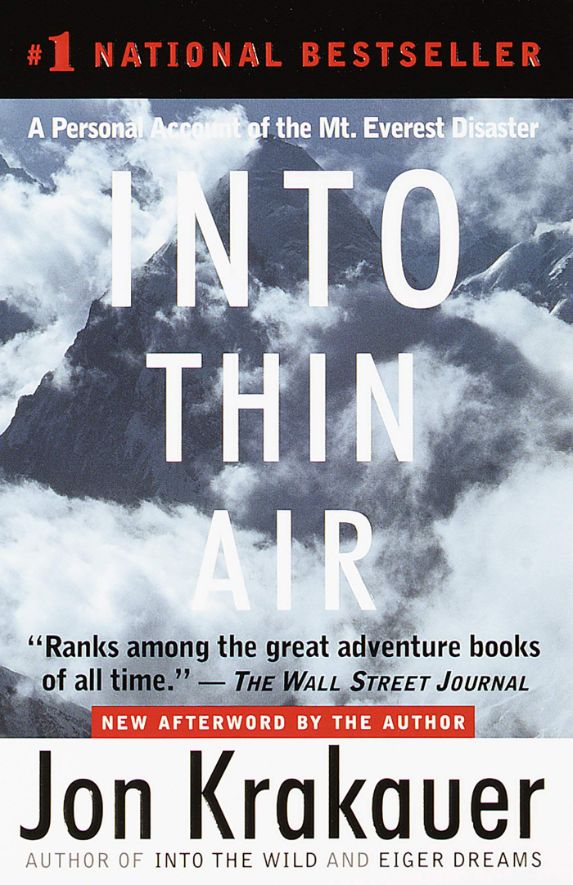
Into Thin Air
Jon Krakauer
When Jon Krakauer reached the summit of Mt. Everest in the early afternoon of May 10, 1996, he hadn’t slept in fifty-seven hours and was reeling from the brain-altering effects of oxygen depletion. As he turned to begin his long, dangerous descent from 29,028 feet, twenty other climbers were still pushing doggedly toward the top. No one had noticed that the sky had
begun to fill with clouds. Six hours later and 3,000 feet lower, in 70-knot winds and blinding snow, Krakauer collapsed in his tent, freezing, hallucinating from exhaustion and hypoxia, but safe. The following morning, he learned that six of his fellow climbers hadn’t made it back to their camp and were desperately struggling for their lives. When the storm finally passed, five of them would be dead, and the sixth so horribly frostbitten that his right hand would have to be amputated.
Into Thin Air is the definitive account of the deadliest season in the history of Everest by the acclaimed journalist and author of the bestseller Into the Wild. On assignment for Outside Magazine to report on the growing commercialization of the mountain, Krakauer, an accomplished climber, went to the Himalayas as a client of Rob Hall, the most respected high-altitude guide in the world. A rangy, thirty-five-year-old New Zealander, Hall had summited Everest four times between 1990 and 1995 and had led thirty-nine climbers to the top. Ascending the mountain in close proximity to Hall’s team was a guided expedition led by Scott Fischer, a forty-year-old American with legendary strength and drive who had climbed the peak without supplemental oxygen in 1994. But neither Hall nor Fischer survived the rogue storm that struck in May 1996.
Krakauer examines what it is about Everest that has compelled so many people — including himself — to throw caution to the wind, ignore the concerns of loved ones, and willingly subject themselves to such risk, hardship, and expense. Written with emotional clarity and supported by his unimpeachable reporting, Krakauer’s eyewitness account of what happened on the roof of the world is a singular achievement.
Into Thin Air is the definitive account of the deadliest season in the history of Everest by the acclaimed journalist and author of the bestseller Into the Wild. On assignment for Outside Magazine to report on the growing commercialization of the mountain, Krakauer, an accomplished climber, went to the Himalayas as a client of Rob Hall, the most respected high-altitude guide in the world. A rangy, thirty-five-year-old New Zealander, Hall had summited Everest four times between 1990 and 1995 and had led thirty-nine climbers to the top. Ascending the mountain in close proximity to Hall’s team was a guided expedition led by Scott Fischer, a forty-year-old American with legendary strength and drive who had climbed the peak without supplemental oxygen in 1994. But neither Hall nor Fischer survived the rogue storm that struck in May 1996.
Krakauer examines what it is about Everest that has compelled so many people — including himself — to throw caution to the wind, ignore the concerns of loved ones, and willingly subject themselves to such risk, hardship, and expense. Written with emotional clarity and supported by his unimpeachable reporting, Krakauer’s eyewitness account of what happened on the roof of the world is a singular achievement.
Categories
Published
1997
Listen to Podcast
“Everest rewards obsession, but obsession can quickly become fatal.”
“Into Thin Air captures terror with breathtaking clarity and emotional honesty.”
“The mountain strips away ego, certainty, and even the instinct to survive.”
“Krakauer transforms catastrophe into unforgettable storytelling.”
Into Thin Air
Nonfiction Reader
0:00
0:00
0:00
Show Podcast Text
Today we’re discussing Into Thin Air, the unforgettable account of the 1996 Mount Everest disaster written by journalist and climber Jon Krakauer. More than just an adventure story, this book is a chilling exploration of ambition, risk, survival, and the terrifying power of nature.
Krakauer joined a commercial Everest expedition originally to write about the growing commercialization of climbing the world’s tallest mountain. Guided by legendary climber Rob Hall, Krakauer expected a difficult but manageable ascent. Instead, he found himself trapped in one of the deadliest disasters in Everest history.
What makes Into Thin Air so gripping is Krakauer’s ability to place readers directly on the mountain. He describes oxygen deprivation, brutal exhaustion, blinding storms, and the psychological effects of extreme altitude with haunting detail. Everest rewards obsession, but obsession can quickly become fatal. The higher climbers ascend, the thinner the line becomes between determination and recklessness.
The memoir also raises difficult ethical questions. Commercial expeditions allowed inexperienced climbers to attempt Everest with guides and bottled oxygen, but the mountain remained unpredictable and merciless. Reviewers often point to the horrifying traffic jams near the summit, where delays cost climbers precious oxygen and valuable time before the storm struck.
Into Thin Air captures terror with breathtaking clarity and emotional honesty. Krakauer does not portray himself as a hero. Instead, he openly wrestles with guilt, confusion, and the impossible decisions climbers faced while fighting to survive.
Many readers say the book permanently cured them of any desire to climb Everest. The mountain strips away ego, certainty, and even the instinct to survive. Krakauer transforms catastrophe into unforgettable storytelling.
Krakauer joined a commercial Everest expedition originally to write about the growing commercialization of climbing the world’s tallest mountain. Guided by legendary climber Rob Hall, Krakauer expected a difficult but manageable ascent. Instead, he found himself trapped in one of the deadliest disasters in Everest history.
What makes Into Thin Air so gripping is Krakauer’s ability to place readers directly on the mountain. He describes oxygen deprivation, brutal exhaustion, blinding storms, and the psychological effects of extreme altitude with haunting detail. Everest rewards obsession, but obsession can quickly become fatal. The higher climbers ascend, the thinner the line becomes between determination and recklessness.
The memoir also raises difficult ethical questions. Commercial expeditions allowed inexperienced climbers to attempt Everest with guides and bottled oxygen, but the mountain remained unpredictable and merciless. Reviewers often point to the horrifying traffic jams near the summit, where delays cost climbers precious oxygen and valuable time before the storm struck.
Into Thin Air captures terror with breathtaking clarity and emotional honesty. Krakauer does not portray himself as a hero. Instead, he openly wrestles with guilt, confusion, and the impossible decisions climbers faced while fighting to survive.
Many readers say the book permanently cured them of any desire to climb Everest. The mountain strips away ego, certainty, and even the instinct to survive. Krakauer transforms catastrophe into unforgettable storytelling.
Buy on Amazon