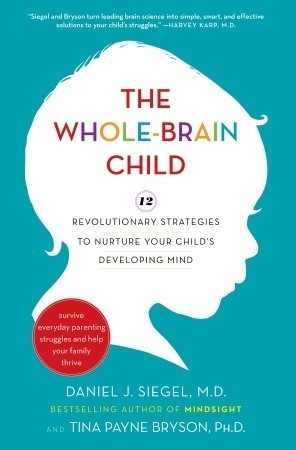
The Whole-Brain Child
Daniel J. Siegel, Tina Payne Bryson
Your toddler throws a tantrum in the middle of a store. Your preschooler refuses to get dressed. Your fifth-grader sulks on the bench instead of playing on the field. Do children conspire to make their parents’ lives endlessly challenging? No—it’s just their developing brain calling the shots! In this pioneering, practical book, Daniel J. Siegel, neuropsychiatrist
and author of the bestselling Mindsight, and parenting expert Tina Payne Bryson demystify the meltdowns and aggravation, explaining the new science of how a child’s brain is wired and how it matures. The “upstairs brain,” which makes decisions and balances emotions, is under construction until the mid-twenties. And especially in young children, the right brain and its emotions tend to rule over the logic of the left brain. No wonder kids can seem—and feel—so out of control. By applying these discoveries to everyday parenting, you can turn any outburst, argument, or fear into a chance to integrate your child’s brain and foster vital growth. Raise calmer, happier children using twelve key strategies, including
• Name It to Tame It: Corral raging right-brain behavior through left-brain storytelling, appealing to the left brain’s affinity for words and reasoning to calm emotional storms and bodily tension.
• Engage, Don’t Enrage: Keep your child thinking and listening, instead of purely reacting.
• Move It or Lose It: Use physical activities to shift your child’s emotional state.
• Let the Clouds of Emotion Roll By: Guide your children when they are stuck on a negative emotion, and help them understand that feelings come and go.
• SIFT: Help children pay attention to the Sensations, Images, Feelings, and Thoughts within them so that they can make better decisions and be more flexible.
• Connect Through Conflict: Use discord to encourage empathy and greater social success.
Complete with clear explanations, age-appropriate strategies for dealing with day-to-day struggles, and illustrations that will help you explain these concepts to your child, The Whole-Brain Child shows you how to cultivate healthy emotional and intellectual development so that your children can lead balanced, meaningful, and connected lives.
• Name It to Tame It: Corral raging right-brain behavior through left-brain storytelling, appealing to the left brain’s affinity for words and reasoning to calm emotional storms and bodily tension.
• Engage, Don’t Enrage: Keep your child thinking and listening, instead of purely reacting.
• Move It or Lose It: Use physical activities to shift your child’s emotional state.
• Let the Clouds of Emotion Roll By: Guide your children when they are stuck on a negative emotion, and help them understand that feelings come and go.
• SIFT: Help children pay attention to the Sensations, Images, Feelings, and Thoughts within them so that they can make better decisions and be more flexible.
• Connect Through Conflict: Use discord to encourage empathy and greater social success.
Complete with clear explanations, age-appropriate strategies for dealing with day-to-day struggles, and illustrations that will help you explain these concepts to your child, The Whole-Brain Child shows you how to cultivate healthy emotional and intellectual development so that your children can lead balanced, meaningful, and connected lives.
Categories
Published
2011
Listen to Podcast
“Connection calms children faster than correction ever will.”
“Big emotions need understanding before they can accept guidance.”
“A child’s brain is growing, not plotting against you.”
“Parenting becomes easier when we understand what behavior really means.”
The Whole-Brain Child
Nonfiction Reader
0:00
0:00
0:00
Show Podcast Text
Today we’re exploring The Whole-Brain Child by Daniel J. Siegel and Tina Payne Bryson, a parenting guide that blends neuroscience with everyday family life. The book begins with a reassuring idea: children are not trying to make life difficult. Their brains are simply still developing.
The authors explain that kids often operate from what they call the “downstairs brain,” where emotions, impulses, and survival reactions dominate. Logic, planning, and emotional regulation belong to the “upstairs brain,” which takes years to fully mature. That insight alone can completely change how parents respond to tantrums, arguments, and emotional meltdowns.
One of the book’s most memorable strategies is “Name It to Tame It.” Instead of dismissing feelings, parents help children describe them with words. Another key lesson is “Connect and Redirect,” meaning emotional connection should come before discipline or problem-solving. The message is simple but powerful: children listen better once they feel understood.
Reviews praise the book for making complicated brain science accessible and practical. Parents especially love the real-life examples, illustrations, and quick-reference summaries. Many readers found the techniques compassionate, respectful, and useful for raising emotionally healthy children. At the same time, some critics argue the neuroscience can feel repetitive or overly simplified, especially discussions about left-brain and right-brain behavior. Others wanted more step-by-step examples for difficult situations.
Still, the heart of the book resonates deeply. It reminds us that parenting is not about perfection. It is about helping children gradually understand emotions, build resilience, and develop healthier relationships with themselves and others.
The authors explain that kids often operate from what they call the “downstairs brain,” where emotions, impulses, and survival reactions dominate. Logic, planning, and emotional regulation belong to the “upstairs brain,” which takes years to fully mature. That insight alone can completely change how parents respond to tantrums, arguments, and emotional meltdowns.
One of the book’s most memorable strategies is “Name It to Tame It.” Instead of dismissing feelings, parents help children describe them with words. Another key lesson is “Connect and Redirect,” meaning emotional connection should come before discipline or problem-solving. The message is simple but powerful: children listen better once they feel understood.
Reviews praise the book for making complicated brain science accessible and practical. Parents especially love the real-life examples, illustrations, and quick-reference summaries. Many readers found the techniques compassionate, respectful, and useful for raising emotionally healthy children. At the same time, some critics argue the neuroscience can feel repetitive or overly simplified, especially discussions about left-brain and right-brain behavior. Others wanted more step-by-step examples for difficult situations.
Still, the heart of the book resonates deeply. It reminds us that parenting is not about perfection. It is about helping children gradually understand emotions, build resilience, and develop healthier relationships with themselves and others.
Buy on Amazon