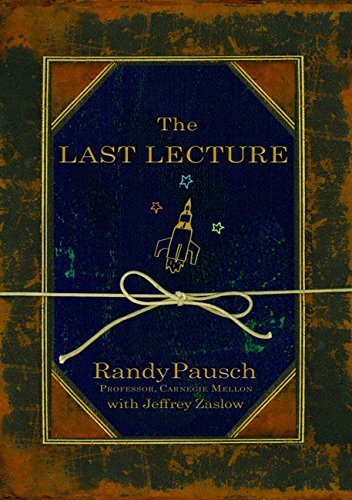
A lot of professors give talks titled ‘The Last Lecture’. Professors are asked to consider their demise and to ruminate on what matters most to them: What wisdom would we impart to the world if we knew it was our last chance? If we had to vanish tomorrow, what would we want as our legacy? When Randy Pausch, a computer science professor at Carnegie Mellon, was
asked to give such a lecture, he didn’t have to imagine it as his last, since he had recently been diagnosed with terminal cancer. But the lecture he gave, ‘Really Achieving Your Childhood Dreams’, wasn’t about dying. It was about the importance of overcoming obstacles, of enabling the dreams of others, of seizing every moment (because time is all you have and you may find one day that you have less than you think). It was a summation of everything Randy had come to believe. It was about living.
In this book, Randy Pausch has combined the humour, inspiration, and intelligence that made his lecture such a phenomenon and given it an indelible form. It is a book that will be shared for generations to come.
“Brick walls reveal how badly we want our dreams.”
“Time is more valuable than we ever realize.”
“Living fully matters more than fearing death.”
“Helping others achieve dreams creates the greatest legacy.”
The Last Lecture
Nonfiction Reader
0:00
0:00
Show Podcast Text
Today, we’re exploring The Last Lecture by Randy Pausch, a book that has inspired millions with its honesty, humor, and unforgettable perspective on life. Originally based on a lecture delivered at Carnegie Mellon University, this memoir became extraordinary because Pausch wasn’t imagining his final days. He had already been diagnosed with terminal pancreatic cancer.
But surprisingly, The Last Lecture is not really about dying. It’s about living well while you still can.
Randy Pausch was a computer science professor, husband, and father of three young children. Faced with limited time, he chose not to focus on despair. Instead, he reflected on childhood dreams, perseverance, gratitude, and the importance of helping others succeed. His message is both deeply personal and universally relatable.
Throughout the book, Pausch shares stories about pursuing goals that once seemed impossible. He talks about becoming a Disney Imagineer, learning teamwork through football, and embracing challenges instead of avoiding them. One of his most memorable lessons is that obstacles exist for a reason. Brick walls, he explains, are there to test determination and commitment.
What makes this book resonate is Pausch’s balance of optimism and realism. He never pretends life is easy, nor does he claim hard work guarantees success. Some critics found the advice overly sentimental or rooted in privilege, while others felt the book focused too heavily on his accomplishments. Yet even many skeptics admit his sincerity and courage are impossible to ignore.
At its core, The Last Lecture asks a simple but profound question: if you knew your time was limited, what wisdom would you leave behind?
Randy Pausch answered with compassion, curiosity, humor, and hope. His story reminds us that life is not measured only by achievements, but by kindness, persistence, and the people whose dreams we help bring alive.