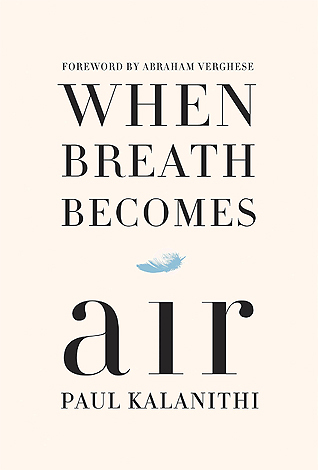
When Breath Becomes Air
Paul Kalanithi
This inspiring, exquisitely observed memoir finds hope and beauty in the face of insurmountable odds as an idealistic young neurosurgeon attempts to answer the question, What makes a life worth living? “Unmissable . . . Finishing this book and then forgetting about it is simply not an option.”—Janet Maslin, The New York Times ONE OF THE BEST BOOKS
OF THE YEAR: The New York Times Book Review, People, NPR, The Washington Post, Slate, Harper’s Bazaar, Time Out New York, Publishers Weekly, BookPage
An Oprah Daily Best Nonfiction Book of the Past Two Decades • A Kirkus Reviews Best Nonfiction Book of the Century
At the age of thirty-six, on the verge of completing a decade’s worth of training as a neurosurgeon, Paul Kalanithi was diagnosed with stage IV lung cancer. One day he was a doctor treating the dying, and the next he was a patient struggling to live. And just like that, the future he and his wife had imagined evaporated. When Breath Becomes Air chronicles Kalanithi’s transformation from a naïve medical student “possessed,” as he wrote, “by the question of what, given that all organisms die, makes a virtuous and meaningful life” into a neurosurgeon at Stanford working in the brain, the most critical place for human identity, and finally into a patient and new father confronting his own mortality.
What makes life worth living in the face of death? What do you do when the future, no longer a ladder toward your goals in life, flattens out into a perpetual present? What does it mean to have a child, to nurture a new life as another fades away? These are some of the questions Kalanithi wrestles with in this profoundly moving, exquisitely observed memoir.
Paul Kalanithi died in March 2015, while working on this book, yet his words live on as a guide and a gift to us all. “I began to realize that coming face to face with my own mortality, in a sense, had changed nothing and everything,” he wrote. “Seven words from Samuel Beckett began to repeat in my head: ‘I can’t go on. I’ll go on.’” When Breath Becomes Air is an unforgettable, life-affirming reflection on the challenge of facing death and on the relationship between doctor and patient, from a brilliant writer who became both—now with an epilogue by Lucy Kalanithi.
Finalist for the PEN Center USA Literary Award in Creative Nonfiction and the Books for a Better Life Award in Inspirational Memoir
An Oprah Daily Best Nonfiction Book of the Past Two Decades • A Kirkus Reviews Best Nonfiction Book of the Century
At the age of thirty-six, on the verge of completing a decade’s worth of training as a neurosurgeon, Paul Kalanithi was diagnosed with stage IV lung cancer. One day he was a doctor treating the dying, and the next he was a patient struggling to live. And just like that, the future he and his wife had imagined evaporated. When Breath Becomes Air chronicles Kalanithi’s transformation from a naïve medical student “possessed,” as he wrote, “by the question of what, given that all organisms die, makes a virtuous and meaningful life” into a neurosurgeon at Stanford working in the brain, the most critical place for human identity, and finally into a patient and new father confronting his own mortality.
What makes life worth living in the face of death? What do you do when the future, no longer a ladder toward your goals in life, flattens out into a perpetual present? What does it mean to have a child, to nurture a new life as another fades away? These are some of the questions Kalanithi wrestles with in this profoundly moving, exquisitely observed memoir.
Paul Kalanithi died in March 2015, while working on this book, yet his words live on as a guide and a gift to us all. “I began to realize that coming face to face with my own mortality, in a sense, had changed nothing and everything,” he wrote. “Seven words from Samuel Beckett began to repeat in my head: ‘I can’t go on. I’ll go on.’” When Breath Becomes Air is an unforgettable, life-affirming reflection on the challenge of facing death and on the relationship between doctor and patient, from a brilliant writer who became both—now with an epilogue by Lucy Kalanithi.
Finalist for the PEN Center USA Literary Award in Creative Nonfiction and the Books for a Better Life Award in Inspirational Memoir
Categories
Published
2016
Listen to Podcast
“Mortality gives life urgency, meaning, and astonishing clarity.”
“He learned medicine while slowly becoming a patient himself.”
“Hope survives even when the future suddenly disappears.”
“Love remained stronger than fear, illness, and approaching death.”
When Breath Becomes Air
Nonfiction Reader
0:00
0:00
0:00
Show Podcast Text
Today, we’re discussing the unforgettable memoir When Breath Becomes Air by Paul Kalanithi, a book that explores medicine, mortality, and what makes life meaningful when time suddenly becomes fragile.
Paul Kalanithi was a brilliant neurosurgeon at Stanford, deeply fascinated by the relationship between the brain, identity, and human purpose. After years of intense medical training, he stood on the edge of a promising career. Then, at only thirty-six years old, he was diagnosed with stage IV lung cancer.
What makes this memoir extraordinary is the perspective Kalanithi brings as both doctor and patient. One day he was guiding families through devastating diagnoses, and the next he was confronting his own approaching death. The shift forces him to ask difficult questions. What gives life meaning? How do we continue living when the future we imagined disappears overnight?
The book balances intellectual reflection with deeply personal moments. Kalanithi writes about the emotional strain of residency, the burden of responsibility surgeons carry, and the complicated humanity behind medicine. But the heart of the memoir lies in his determination to keep living fully, even while dying.
Readers often describe the book as heartbreaking, yet profoundly life-affirming. Some praise Kalanithi’s elegant literary voice and philosophical insight, while others connect most deeply with the epilogue written by his wife, Lucy, after his death. Her closing reflections transform the memoir into something even more intimate and unforgettable.
At its core, this book reminds us that death is not separate from life. Instead, awareness of mortality sharpens our appreciation for love, relationships, purpose, and the limited time we share with one another.
Paul Kalanithi was a brilliant neurosurgeon at Stanford, deeply fascinated by the relationship between the brain, identity, and human purpose. After years of intense medical training, he stood on the edge of a promising career. Then, at only thirty-six years old, he was diagnosed with stage IV lung cancer.
What makes this memoir extraordinary is the perspective Kalanithi brings as both doctor and patient. One day he was guiding families through devastating diagnoses, and the next he was confronting his own approaching death. The shift forces him to ask difficult questions. What gives life meaning? How do we continue living when the future we imagined disappears overnight?
The book balances intellectual reflection with deeply personal moments. Kalanithi writes about the emotional strain of residency, the burden of responsibility surgeons carry, and the complicated humanity behind medicine. But the heart of the memoir lies in his determination to keep living fully, even while dying.
Readers often describe the book as heartbreaking, yet profoundly life-affirming. Some praise Kalanithi’s elegant literary voice and philosophical insight, while others connect most deeply with the epilogue written by his wife, Lucy, after his death. Her closing reflections transform the memoir into something even more intimate and unforgettable.
At its core, this book reminds us that death is not separate from life. Instead, awareness of mortality sharpens our appreciation for love, relationships, purpose, and the limited time we share with one another.
Buy on Amazon