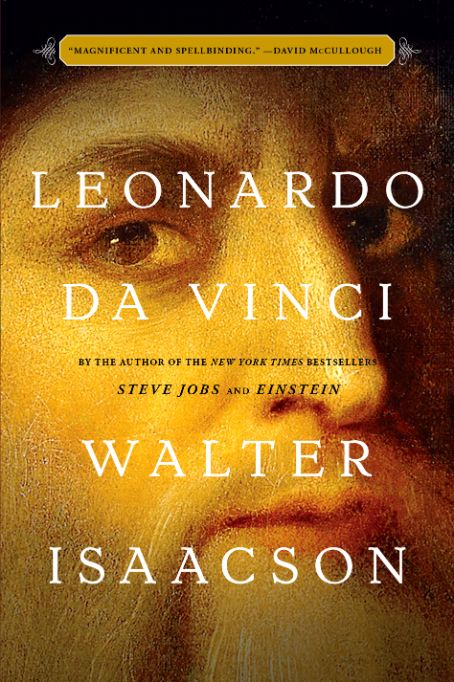
Based on thousands of pages from Leonardo’s astonishing notebooks and new discoveries about his life and work, Walter Isaacson weaves a narrative that connects his art to his science. He shows how Leonardo’s genius was based on skills we can improve in ourselves, such as passionate curiosity, careful observation, and an imagination so playful that it flirted with
fantasy. He produced the two most famous paintings in history, The Last Supper and the Mona Lisa. But in his own mind, he was just as much a man of science and technology. With a passion that sometimes became obsessive, he pursued innovative studies of anatomy, fossils, birds, the heart, flying machines, botany, geology, and weaponry. His ability to stand at the crossroads of the humanities and the sciences, made iconic by his drawing of Vitruvian Man, made him history’s most creative genius
“He painted beauty while dissecting the mechanics beneath it.”
“Leonardo turned observation into a lifelong adventure.”
“Genius begins with wonder and relentless attention.”
Leonardo da Vinci
Nonfiction Reader
0:00
0:00
Show Podcast Text
Today, we’re exploring Leonardo da Vinci by Walter Isaacson, a sweeping portrait of one of history’s most extraordinary minds. This isn’t just the story of a painter. It’s the story of a man who blurred the boundaries between art, engineering, anatomy, imagination, and science centuries before the modern world caught up.
Isaacson draws from thousands of notebook pages left behind by Leonardo da Vinci, revealing a genius powered less by perfection and more by relentless curiosity. Leonardo studied everything. The flow of rivers. The anatomy of horses. The mechanics of flight. The muscles behind a smile. Curiosity was Leonardo’s greatest masterpiece.
The book also highlights the contradictions that made him deeply human. Leonardo created some of the world’s most celebrated paintings, including Mona Lisa and The Last Supper, yet he left many projects unfinished. His imagination constantly pulled him toward new questions, new inventions, and new obsessions. He painted beauty while dissecting the mechanics beneath it.
What makes this biography so compelling is Isaacson’s argument that Leonardo’s brilliance wasn’t magical or unreachable. He wasn’t a perfect student or mathematical prodigy. Instead, his genius came from observation, experimentation, and an endless willingness to ask why. Leonardo turned observation into a lifelong adventure.
At its heart, this book celebrates human potential. It reminds us that creativity flourishes when disciplines collide, when curiosity overrides convention, and when wonder survives adulthood. Genius begins with wonder and relentless attention.