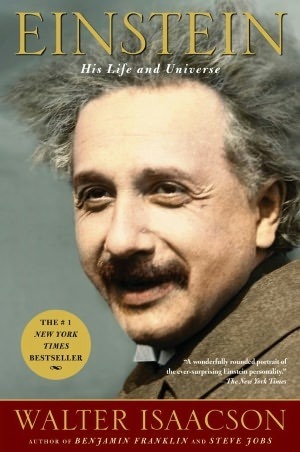
Einstein was a rebel and nonconformist from boyhood days, and these character traits drove both his life and his science. In this narrative, Walter Isaacson explains how his mind worked and the mysteries of the universe that he discovered.
“Einstein’s curiosity reshaped humanity’s understanding of space and time.”
“Imagination guided Einstein beyond the limits of conventional thinking.”
“He challenged authority with both science and moral conviction.”
“Einstein proved that wonder can change the course of history.”
Einstein
Nonfiction Reader
0:00
0:00
Show Podcast Text
Today we’re exploring the remarkable life of one of history’s greatest minds through Einstein by Walter Isaacson. More than a biography, this book is a portrait of a man whose rebellious spirit transformed science and changed the modern world forever.
From childhood, Albert Einstein questioned authority, rejected rigid learning, and followed curiosity wherever it led. One of the defining moments of his youth came when his father handed him a compass. Watching the needle move under invisible forces filled Einstein with wonder and sparked a lifelong fascination with the hidden laws governing the universe.
Isaacson carefully traces Einstein’s journey from struggling patent clerk to global scientific icon. In 1905, his so-called miracle year, Einstein published groundbreaking papers on light, atoms, motion, and relativity. These discoveries completely redefined how humanity understood space, time, energy, and reality itself. Yet despite changing physics forever, Einstein remained deeply human — playful, absentminded, idealistic, and often conflicted in his personal relationships.
The book also highlights Einstein’s moral courage. During both world wars, he spoke passionately against nationalism and violence. As anti-Semitism rose in Germany, Einstein became an outspoken defender of intellectual freedom and human dignity. Later in life, he struggled with the consequences of nuclear weapons, regretting the role his warning to political leaders played in the atomic age.
What makes Einstein so compelling is the balance between science and personality. Isaacson doesn’t just explain Einstein’s theories; he reveals the imagination and independence that made those theories possible. Einstein believed curiosity mattered more than obedience, and imagination mattered more than memorization.
Ultimately, this biography reminds us that genius is not only intelligence. It is the courage to wonder differently from everyone else.