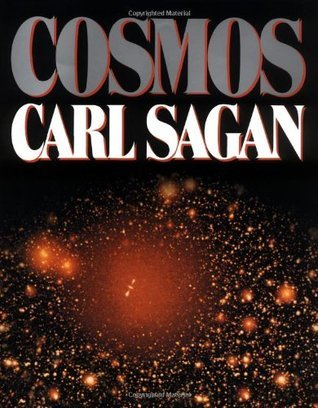
This visually stunning book with over 250 full-color illustrations, many of them never before published, is based on Carl Sagan’s thirteen-part television series. Told with Sagan’s remarkable ability to make scientific ideas both comprehensible and exciting, Cosmos is about science in its broadest human context, how science and civilization grew up together. The
book also explores spacecraft missions of discovery of the nearby planets, the research in the Library of ancient Alexandria, the human brain, Egyptian hieroglyphics, the origin of life, the death of the Sun, the evolution of galaxies and the origins of matter, suns and worlds.
Sagan retraces the fifteen billion years of cos-mic evolution that have transformed matter into life and consciousness, enabling the Cosmos to wonder about itself. He considers the latest findings on life elsewhere and how we might communicate with the beings of other worlds.
Cosmos is the story of our long journey of discovery and the forces and individuals who helped to shape modern science, including Democritus, Hypatia, Kepler, Newton, Huy-gens, Champollion, Lowell and Humason. Sagan looks at our planet from an extra-terrestrial vantage point and sees a blue jewel-like world, inhabited by a lifeform that is just beginning to discover its own unity and to ven-ture into the vast ocean of space.
“We are stardust learning to understand the universe itself.”
“Science becomes poetry in Sagan’s hands.”
“The cosmos reminds humanity how small and precious life truly is.”
“Curiosity is humanity’s greatest survival tool.”
Cosmos
Nonfiction Reader
0:00
0:00
Show Podcast Text
Today, we’re exploring Cosmos, the groundbreaking masterpiece by Carl Sagan that transformed science writing into something deeply human, emotional, and unforgettable. More than a book about stars and galaxies, Cosmos is an invitation to rethink humanity’s place in the universe.
Sagan takes listeners and readers on a breathtaking journey across space and time, from the ancient Library of Alexandria to distant galaxies billions of light-years away. Along the way, he explains astronomy, evolution, physics, and the origins of life with remarkable clarity and wonder. Science becomes poetry in Sagan’s hands.
What makes Cosmos endure decades after publication is not just its scientific insight, but its compassion. Sagan argues that science is more than facts and formulas; it is a way of thinking, a defense against ignorance, superstition, and division. He reminds us that every civilization, every war, every triumph in human history happened on what he famously described as a pale blue world drifting through an immense cosmic ocean.
Readers consistently describe the book as life-changing. Some call it required reading for humanity itself. Others praise Sagan’s ability to connect astronomy with philosophy, history, and hope. Even complex scientific ideas feel accessible because his voice is filled with awe rather than arrogance.
The cosmos reminds humanity how small and precious life truly is. Yet Sagan never leaves us feeling insignificant. Instead, he celebrates the miracle that the universe produced conscious beings capable of studying the stars and wondering about their origins.
In the end, Cosmos is about curiosity, humility, and survival. We are stardust learning to understand the universe itself. And according to Sagan, that search for understanding may be humanity’s greatest achievement.