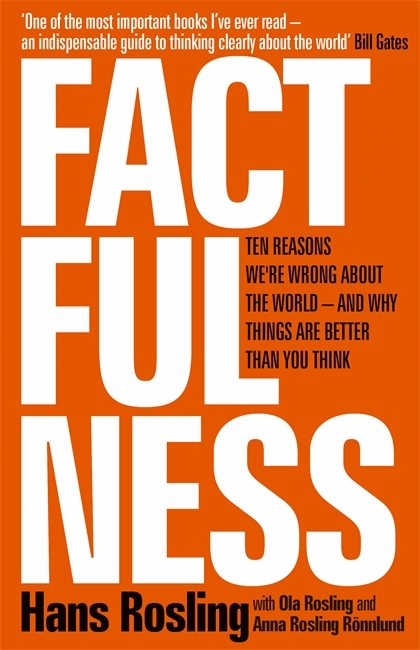
Factfulness: The stress-reducing habit of only carrying opinions for which you have strong supporting facts. When asked simple questions about global trends—what percentage of the world’s population live in poverty; why the world’s population is increasing; how many girls finish school—we systematically get the answers wrong. So wrong that a chimpanzee
choosing answers at random will consistently outguess teachers, journalists, Nobel laureates, and investment bankers.
In Factfulness, Professor of International Health and global TED phenomenon Hans Rosling, together with his two long-time collaborators, Anna and Ola, offers a radical new explanation of why this happens. They reveal the ten instincts that distort our perspective—from our tendency to divide the world into two camps (usually some version of us and them) to the way we consume media (where fear rules) to how we perceive progress (believing that most things are getting worse).
Our problem is that we don’t know what we don’t know, and even our guesses are informed by unconscious and predictable biases.
It turns out that the world, for all its imperfections, is in a much better state than we might think. That doesn’t mean there aren’t real concerns. But when we worry about everything all the time instead of embracing a worldview based on facts, we can lose our ability to focus on the things that threaten us most.
Inspiring and revelatory, filled with lively anecdotes and moving stories, Factfulness is an urgent and essential book that will change the way you see the world and empower you to respond to the crises and opportunities of the future.
“Fear distorts reality faster than facts can correct it”
“Progress is often invisible because it arrives quietly”
“The world can be imperfect and still be improving”
“Factfulness challenges panic with patience, evidence, and perspective”
Factfulness
Nonfiction Reader
0:00
0:00
Show Podcast Text
Today we’re diving into Factfulness by Hans Rosling, a book that completely reframes how we see the modern world. Co-written with Anna Rosling Rönnlund and Ola Rosling, this bestseller argues that most of us—even educated experts—consistently misunderstand global progress.
Rosling opens with a shocking idea: chimpanzees answering random multiple-choice questions often outperform humans on topics like poverty, education, and life expectancy. Why? Because our instincts are wired toward fear, negativity, and dramatic storytelling. News headlines train us to believe the world is constantly getting worse, even when data shows enormous improvements in health, education, and living standards.
The book breaks these misconceptions into ten mental habits, including the fear instinct, the gap instinct, and the size instinct. Rosling explains how we oversimplify the world into “developed” and “developing” countries, when reality is far more nuanced. His four-level income framework paints a clearer picture of how billions of people actually live.
What makes Factfulness compelling is its balance between optimism and realism. Rosling never claims the world is perfect. Climate change, inequality, and humanitarian crises remain urgent. But he insists we respond to problems with accurate information instead of panic. The world can be imperfect and still be improving.
The reviews surrounding this book reflect that tension. Some readers praise its hopeful, data-driven perspective and accessible storytelling. Others criticize it for overlooking environmental and political complexities. Yet even critics admit the book sparks important conversations about statistics, bias, and how narratives shape public opinion.
Ultimately, Factfulness is less about memorizing numbers and more about developing a calmer, evidence-based mindset. It challenges readers to question assumptions, resist sensationalism, and replace fear with informed curiosity.