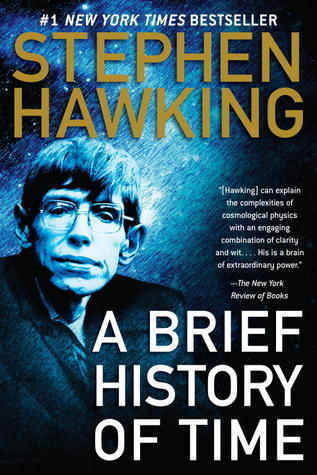
A landmark volume in science writing by one of the great minds of our time, Stephen Hawking’s book explores such profound questions as: How did the universe begin—and what made its start possible? Does time always flow forward? Is the universe unending—or are there boundaries? Are there other dimensions in space? What will happen when it all ends? Told in language
we all can understand, A Brief History of Time plunges into the exotic realms of black holes and quarks, of antimatter and “arrows of time,” of the big bang and a bigger God—where the possibilities are wondrous and unexpected. With exciting images and profound imagination, Stephen Hawking brings us closer to the ultimate secrets at the very heart of creation.
“The universe expands faster than our certainty about it.”
“Black holes challenge everything we think we know about reality.”
“Time is not as fixed as human experience suggests.”
“Curiosity may be humanity’s greatest force.”
A Brief History of Time
Nonfiction Reader
0:00
0:00
Show Podcast Text
Today we’re exploring A Brief History of Time, Stephen Hawking’s groundbreaking journey through black holes, relativity, quantum mechanics, and the origins of the universe itself. Few science books have inspired as much fascination, confusion, and awe all at once.
Hawking takes readers into questions humanity has wrestled with for centuries. How did the universe begin? Does time have a starting point? Could the cosmos eventually collapse back into itself? And perhaps most importantly, can ordinary people truly understand these mysteries?
What makes this book remarkable is Hawking’s determination to translate impossibly large ideas into language accessible to curious readers. He guides us from Isaac Newton to Einstein, from gravity to spacetime, explaining how scientific thinking transformed our understanding of existence. Readers repeatedly praise the book’s ambition and imagination, even while admitting some sections feel overwhelming. Quantum mechanics and imaginary time leave many fascinated and completely lost at the same moment.
One of the book’s most memorable themes is the expanding universe. Hawking explains that galaxies continue drifting apart, suggesting the cosmos began in an unimaginably dense moment we now call the Big Bang. From there, he explores black holes, strange regions where gravity becomes so powerful that not even light escapes.
Reviews of the book often reflect two emotions simultaneously: inspiration and humility. Many readers feel intellectually energized, while others joke that Hawking gently reminds them how little they truly understand. Yet that tension may be the point. Science is not only about answers. It is about wonder.
A Brief History of Time remains a landmark because it invites readers to look upward, think deeper, and embrace curiosity, even when the universe refuses to give easy explanations.