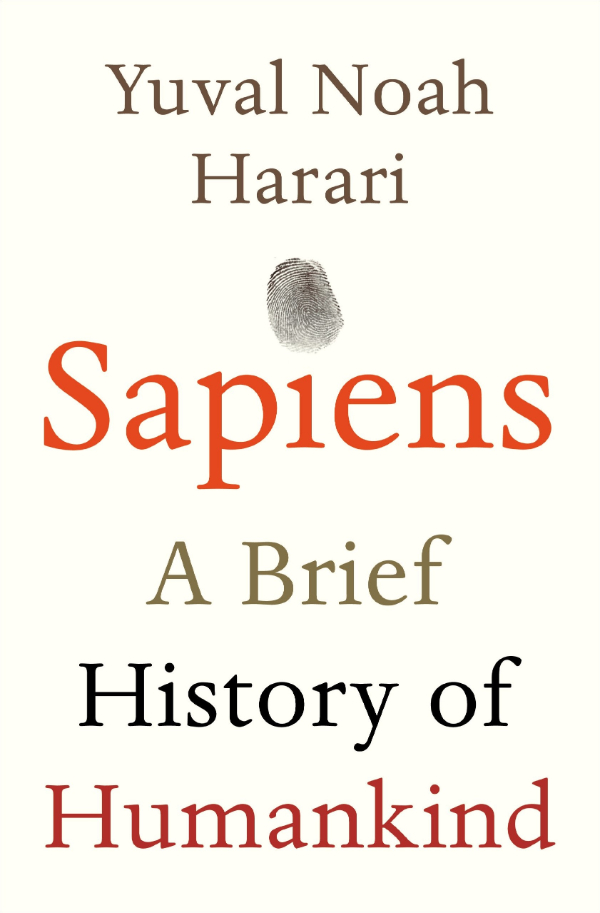
Yuval Noah Harari, Prottasha Prachurjo Sayed Fayej Ahmed
From a renowned historian comes a groundbreaking narrative of humanity’s creation and evolution—a #1 international bestseller—that explores the ways in which biology and history have defined us and enhanced our understanding of what it means to be “human.” One hundred thousand years ago, at least six different species of humans inhabited Earth. Yet today there is
only one—homo sapiens. What happened to the others? And what may happen to us? Most books about the history of humanity pursue either a historical or a biological approach, but Dr. Yuval Noah Harari breaks the mold with this highly original book that begins about 70,000 years ago with the appearance of modern cognition. From examining the role evolving humans have played in the global ecosystem to charting the rise of empires, Sapiens integrates history and science to reconsider accepted narratives, connect past developments with contemporary concerns, and examine specific events within the context of larger ideas. Dr. Harari also compels us to look ahead, because over the last few decades humans have begun to bend laws of natural selection that have governed life for the past four billion years. We are acquiring the ability to design not only the world around us, but also ourselves. Where is this leading us, and what do we want to become? Featuring 27 photographs, 6 maps, and 25 illustrations/diagrams, this provocative and insightful work is sure to spark debate and is essential reading for aficionados of Jared Diamond, James Gleick, Matt Ridley, Robert Wright, and Sharon Moalem.
“Humanity’s greatest power may be our ability to believe shared stories.”
“Agriculture changed civilization, but did it truly improve human happiness?”
“Money, empires, and nations exist because people collectively believe they do.”
“Sapiens challenges readers to rethink progress, power, and the future of humanity.”
Sapiens
Nonfiction Reader
0:00
0:00
Show Podcast Text
Today we’re exploring Sapiens by Yuval Noah Harari, a sweeping examination of humanity’s rise from insignificant apes to rulers of the planet. Harari blends history, biology, anthropology, and philosophy into a fast-moving narrative that asks one enormous question: how did Homo sapiens come to dominate Earth while every other human species disappeared?
The book begins roughly seventy thousand years ago with what Harari calls the Cognitive Revolution, when humans developed the ability to create myths, stories, and shared beliefs. According to Harari, this talent allowed strangers to cooperate on massive scales, eventually building kingdoms, religions, corporations, and entire civilizations. Humanity’s greatest power may be our ability to believe shared stories.
One of the book’s most debated ideas involves the Agricultural Revolution. Harari provocatively argues that farming may have trapped humans in harder, less satisfying lives despite creating larger societies and technological advancement. Agriculture changed civilization, but did it truly improve human happiness? Critics challenge this argument, saying the book sometimes sacrifices scientific precision for dramatic storytelling. Yet even skeptical readers admit Harari raises fascinating questions.
Another memorable theme is Harari’s discussion of money, empires, and political systems as collective fictions powerful enough to organize billions of people. Money, empires, and nations exist because people collectively believe they do. Whether readers find these arguments brilliant or oversimplified, the ideas are undeniably thought-provoking.
What makes Sapiens so compelling is its willingness to connect ancient history with humanity’s future. Harari warns that science and technology may soon allow humans to redesign life itself. Sapiens challenges readers to rethink progress, power, and the future of humanity.