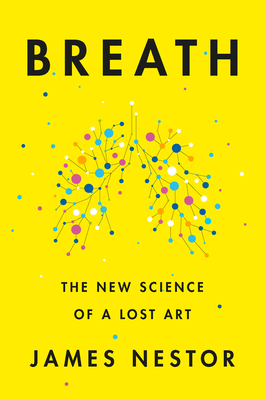
No matter what you eat, how much you exercise, how skinny or young or wise you are, none of it matters if you’re not breathing properly. There is nothing more essential to our health and well-being than breathing: take air in, let it out, repeat twenty-five thousand times a day. Yet, as a species, humans have lost the ability to breathe correctly, with grave consequences. Journalist
James Nestor travels the world to figure out what went wrong and how to fix it. The answers aren’t found in pulmonology labs, as we might expect, but in the muddy digs of ancient burial sites, secret Soviet facilities, New Jersey choir schools, and the smoggy streets of Sao Paulo. Nestor tracks down men and women exploring the hidden science behind ancient breathing practices like Pranayama, Sudarshan Kriya, and Tummo and teams up with pulmonary tinkerers to scientifically test long-held beliefs about how we breathe.
Modern research is showing us that making even slight adjustments to the way we inhale and exhale can jump-start athletic performance; rejuvenate internal organs; halt snoring, asthma, and autoimmune disease; and even straighten scoliotic spines. None of this should be possible, and yet it is.
Drawing on thousands of years of medical texts and recent cutting-edge studies in pulmonology, psychology, biochemistry, and human physiology, Breath turns the conventional wisdom of what we thought we knew about our most basic biological function on its head. You will never breathe the same again.
Today, we’re diving into Breath by James Nestor, a fascinating and controversial exploration of one of the most overlooked functions in human life: breathing.
Nestor begins with a startling premise. No matter how healthy we think we are, none of it matters if we’re breathing incorrectly. The way we breathe may shape the way we live. Across the book, he travels through ancient practices, modern laboratories, and personal experiments to understand how humans lost the ability to breathe well and what we can do about it.
One of the book’s strongest arguments centers on nasal breathing. Nestor suggests that many modern health issues, from poor sleep to stress and fatigue, may be connected to chronic mouth breathing. Modern humans forgot how to breathe properly. He combines stories from athletes, monks, researchers, and patients with discussions about techniques like Pranayama, slow breathing, and breath retention.
What makes the book compelling is its ability to make readers suddenly aware of something they normally ignore. Every breath becomes noticeable. Every inhale feels important. Breathing slowly can calm both body and mind. Many readers found the techniques transformative, reporting better sleep, reduced anxiety, and improved focus after practicing simple breathing exercises.
At the same time, the book has sparked criticism. Some reviewers questioned whether the science behind certain claims was rigorous enough, arguing that anecdotal evidence occasionally outweighed peer-reviewed research. Even so, many agreed that the core message remains valuable: paying attention to breathing can improve awareness, relaxation, and overall well-being.
Ultimately, Breath is less about miracle cures and more about rediscovering a forgotten connection between body and mind. Health begins with the breath we ignore daily.