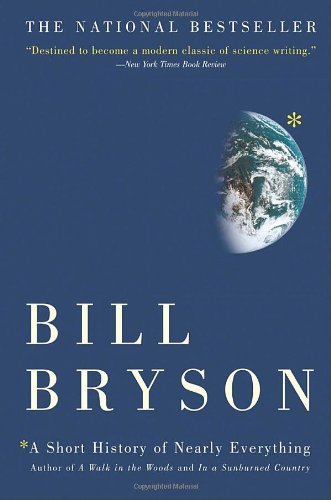
Bill Bryson describes himself as a reluctant traveller, but even when he stays safely at home he can’t contain his curiosity about the world around him. “A Short History of Nearly Everything” is his quest to understand everything that has happened from the Big Bang to the rise of civilisation – how we got from there, being nothing at all, to here, being us. The ultimate
“Science becomes unforgettable when curiosity replaces intimidation.”
“The universe is stranger, larger, and more fragile than we ever imagine.”
“Bryson turns complex discoveries into stories filled with wonder and humor.”
“Nearly everything began with questions nobody could fully answer.”
A Short History of Nearly Everything
Nonfiction Reader
0:00
0:00
Show Podcast Text
Today we’re diving into A Short History of Nearly Everything by Bill Bryson, a wildly entertaining exploration of science, discovery, and humanity’s endless curiosity about the universe.
This book attempts something incredibly ambitious: explaining nearly everything. From the Big Bang to dinosaurs, atoms, geology, evolution, and the rise of civilization, Bryson guides readers through the history of scientific understanding with humor, clarity, and genuine amazement.
What makes the book stand out is Bryson’s ability to make intimidating subjects approachable. Readers repeatedly praise how accessible the writing feels, even when discussing quantum physics or cosmology. Instead of drowning audiences in equations, Bryson focuses on the strange personalities, accidental discoveries, and bizarre moments that shaped science itself. One reviewer joked that if textbooks had been written this way in school, they might have become scientists.
The book also captures a childlike sense of wonder. Bryson constantly reminds us how little we truly know about the universe. He highlights the fragile chain of events that allowed humanity to exist at all, while celebrating the scientists who spent lifetimes searching for answers.
Not every reader loved the experience equally. Some felt the endless stream of information became overwhelming, while others thought Bryson’s humor occasionally drifted into smugness. A few pointed out scientific inaccuracies or simplifications. But even critics admitted the book remained fascinating and deeply informative.
Ultimately, A Short History of Nearly Everything succeeds because it transforms science into storytelling. It reminds us that discovery is not just about facts and formulas. It’s about curiosity, persistence, failure, and wonder.
In the end, Bryson leaves readers with a humbling realization: we occupy a tiny place in an unimaginably vast universe, yet our desire to understand it may be one of humanity’s greatest achievements.