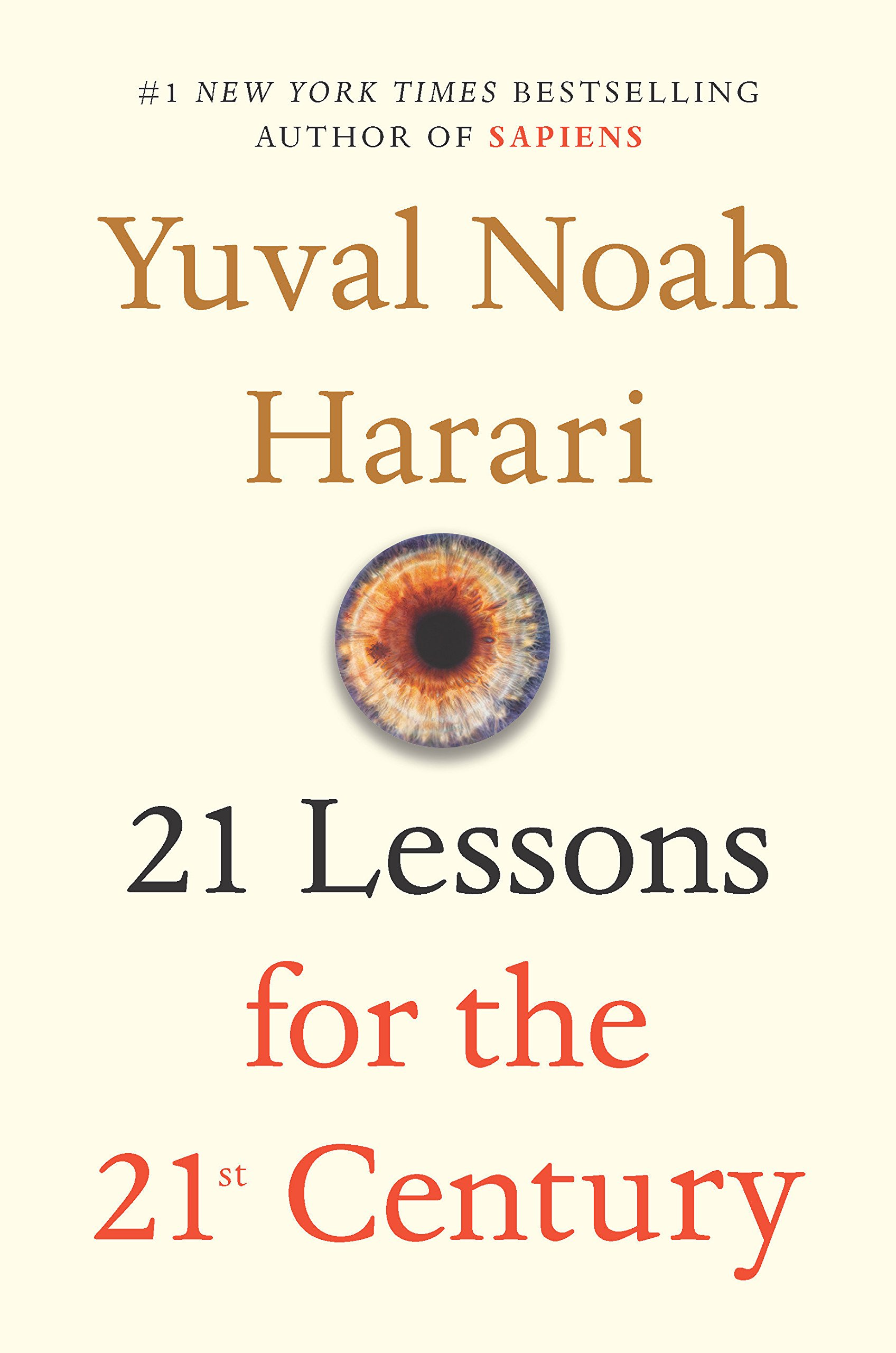
21 Lessons for the 21st Century
Yuval Noah Harari
In Sapiens, he explored our past. In Homo Deus, he looked to our future. Now, one of the most innovative thinkers on the planet turns to the present to make sense of today’s most pressing issues. How do computers and robots change the meaning of being human? How do we deal with the epidemic of fake news? Are nations and religions still relevant? What should
we teach our children?
Yuval Noah Harari’s 21 Lessons for the 21st Century is a probing and visionary investigation into today’s most urgent issues as we move into the uncharted territory of the future. As technology advances faster than our understanding of it, hacking becomes a tactic of war, and the world feels more polarized than ever, Harari addresses the challenge of navigating life in the face of constant and disorienting change and raises the important questions we need to ask ourselves in order to survive.
In twenty-one accessible chapters that are both provocative and profound, Harari builds on the ideas explored in his previous books, untangling political, technological, social, and existential issues and offering advice on how to prepare for a very different future from the world we now live in: How can we retain freedom of choice when Big Data is watching us? What will the future workforce look like, and how should we ready ourselves for it? How should we deal with the threat of terrorism? Why is liberal democracy in crisis?
Harari’s unique ability to make sense of where we have come from and where we are going has captured the imaginations of millions of readers. Here he invites us to consider values, meaning, and personal engagement in a world full of noise and uncertainty. When we are deluged with irrelevant information, clarity is power. Presenting complex contemporary challenges clearly and accessibly, 21 Lessons for the 21st Century is essential reading.
Yuval Noah Harari’s 21 Lessons for the 21st Century is a probing and visionary investigation into today’s most urgent issues as we move into the uncharted territory of the future. As technology advances faster than our understanding of it, hacking becomes a tactic of war, and the world feels more polarized than ever, Harari addresses the challenge of navigating life in the face of constant and disorienting change and raises the important questions we need to ask ourselves in order to survive.
In twenty-one accessible chapters that are both provocative and profound, Harari builds on the ideas explored in his previous books, untangling political, technological, social, and existential issues and offering advice on how to prepare for a very different future from the world we now live in: How can we retain freedom of choice when Big Data is watching us? What will the future workforce look like, and how should we ready ourselves for it? How should we deal with the threat of terrorism? Why is liberal democracy in crisis?
Harari’s unique ability to make sense of where we have come from and where we are going has captured the imaginations of millions of readers. Here he invites us to consider values, meaning, and personal engagement in a world full of noise and uncertainty. When we are deluged with irrelevant information, clarity is power. Presenting complex contemporary challenges clearly and accessibly, 21 Lessons for the 21st Century is essential reading.
Categories
Published
2018
Listen to Podcast
“Clarity is power in an age overwhelmed by information.”
“Technology evolves faster than humanity understands its consequences.”
“Fake news is old deception wearing modern clothes.”
“The future is shaped by choices, not inevitability.”
21 Lessons for the 21st Century
Nonfiction Reader
0:00
0:00
0:00
Show Podcast Text
Today we’re diving into 21 Lessons for the 21st Century by Yuval Noah Harari, a provocative exploration of the challenges shaping our modern world. Following his bestselling books Sapiens and Homo Deus, Harari shifts his focus from humanity’s past and future to the urgent questions of the present.
This book tackles massive topics: artificial intelligence, fake news, nationalism, religion, terrorism, climate change, and the growing influence of data and surveillance. Yet what makes Harari stand out is his ability to translate overwhelming global issues into ideas that feel understandable and deeply personal. Many reviewers praised how accessible his writing is, even when discussing incredibly complex political and technological concepts.
One recurring theme throughout the book is uncertainty. Harari argues that modern society is flooded with information but starved for wisdom. In a world shaped by algorithms, misinformation, and constant distraction, he believes the most valuable skill may simply be the ability to think clearly. Several readers appreciated how the book encourages humility, mindfulness, and critical thinking instead of pretending to offer simple solutions.
The reviews also reveal some criticism. Some readers felt the book spread itself too thin, touching on subjects that could each deserve entire books of their own. Others wanted more practical answers instead of philosophical reflections. Still, even critics admitted the ideas are engaging and difficult to ignore.
What resonates most is Harari’s warning that the future is not fixed. Technology may reshape jobs, politics, and identity itself, but humanity still has choices. He challenges readers to stay informed without becoming overwhelmed and to balance innovation with empathy and self-awareness.
Ultimately, 21 Lessons for the 21st Century is less about predicting tomorrow and more about understanding the complicated world we already live in today.
This book tackles massive topics: artificial intelligence, fake news, nationalism, religion, terrorism, climate change, and the growing influence of data and surveillance. Yet what makes Harari stand out is his ability to translate overwhelming global issues into ideas that feel understandable and deeply personal. Many reviewers praised how accessible his writing is, even when discussing incredibly complex political and technological concepts.
One recurring theme throughout the book is uncertainty. Harari argues that modern society is flooded with information but starved for wisdom. In a world shaped by algorithms, misinformation, and constant distraction, he believes the most valuable skill may simply be the ability to think clearly. Several readers appreciated how the book encourages humility, mindfulness, and critical thinking instead of pretending to offer simple solutions.
The reviews also reveal some criticism. Some readers felt the book spread itself too thin, touching on subjects that could each deserve entire books of their own. Others wanted more practical answers instead of philosophical reflections. Still, even critics admitted the ideas are engaging and difficult to ignore.
What resonates most is Harari’s warning that the future is not fixed. Technology may reshape jobs, politics, and identity itself, but humanity still has choices. He challenges readers to stay informed without becoming overwhelmed and to balance innovation with empathy and self-awareness.
Ultimately, 21 Lessons for the 21st Century is less about predicting tomorrow and more about understanding the complicated world we already live in today.
Buy on Amazon