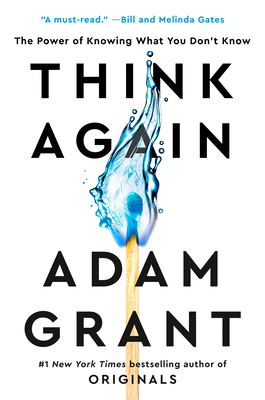
Think Again is a book about the benefit of doubt, and about how we can get better at embracing the unknown and the joy of being wrong. Evidence has shown that creative geniuses are not attached to one identity, but constantly willing to rethink their stances and that leaders who admit they don’t know something and seek critical feedback lead more productive
New evidence shows us that as a mindset and a skilllset, rethinking can be taught and Grant explains how to develop the necessary qualities to do it. Section 1 explores why we struggle to think again and how we can learn to do it as individuals, arguing that ‘grit’ alone can actually be counterproductive. Section 2 discusses how we can help others think again through learning about ‘argument literacy’. And the final section 3 looks at how schools, businesses and governments fall short in building cultures that encourage rethinking.
In the end, learning to rethink may be the secret skill to give you the edge in a world changing faster than ever.
“Confidence grows stronger when paired with curiosity.”
“Rethinking is not weakness
it is intellectual courage.”
“The smartest people revise beliefs before reality forces them to.”
Think Again
Nonfiction Reader
0:00
0:00
Show Podcast Text
Today, we’re exploring Think Again by Adam Grant, a fascinating book about the power of rethinking what we believe. In a world overflowing with opinions, certainty, and online arguments, Grant makes a surprisingly refreshing case: the ability to change your mind may be one of the most valuable skills you can develop.
At the heart of the book is a simple but challenging idea. Most of us think of intelligence as the ability to think quickly or defend our views convincingly. Grant argues that true intelligence also means being willing to question our assumptions and update our beliefs when new evidence appears.
He describes how people often slip into the roles of preacher, prosecutor, or politician. We preach when defending our beliefs, prosecute when attacking opposing views, and politic when trying to win approval. But none of those mindsets encourage learning. Instead, Grant suggests adopting the mindset of a scientist: testing ideas, staying curious, and accepting that being wrong can actually move us closer to the truth.
One of the book’s strongest messages is that confidence and humility can coexist. You can believe in your ability to learn without pretending you already know everything. Grant uses examples from business leaders, entrepreneurs, teachers, and negotiators to show how flexible thinking often leads to better decisions and stronger relationships.
The book also explores persuasion. Instead of overpowering people in arguments, Grant recommends asking thoughtful questions and creating conversations where people discover new perspectives themselves. It’s less about winning debates and more about expanding understanding.
Ultimately, Think Again reminds us that growth depends on curiosity. In a rapidly changing world, the people most prepared for the future may not be those who always sound certain, but those willing to rethink, relearn, and evolve.