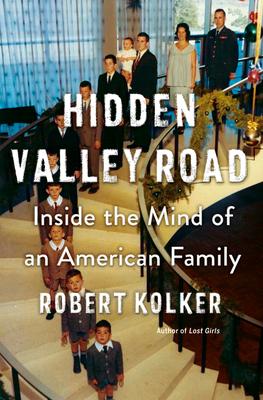
The heartrending story of a midcentury American family with twelve children, six of them diagnosed with schizophrenia, that became science’s great hope in the quest to understand the disease. Don and Mimi Galvin seemed to be living the American dream. After World War II, Don’s work with the Air Force brought them to Colorado, where their twelve children perfectly
spanned the baby boom: the oldest born in 1945, the youngest in 1965. In those years, there was an established script for a family like the Galvins—aspiration, hard work, upward mobility, domestic harmony—and they worked hard to play their parts. But behind the scenes was a different story: psychological breakdown, sudden shocking violence, hidden abuse. By the mid-1970s, six of the ten Galvin boys, one after another, were diagnosed as schizophrenic. How could all this happen to one family?
What took place inside the house on Hidden Valley Road was so extraordinary that the Galvins became one of the first families to be studied by the National Institute of Mental Health. Their story offers a shadow history of the science of schizophrenia, from the era of institutionalization, lobotomy, and the schizophrenogenic mother to the search for genetic markers for the disease, always amid profound disagreements about the nature of the illness itself. And unbeknownst to the Galvins, samples of their DNA informed decades of genetic research that continues today, offering paths to treatment, prediction, and even eradication of the disease for future generations.
With clarity and compassion, bestselling and award-winning author Robert Kolker uncovers one family’s unforgettable legacy of suffering, love, and hope.
“Mental illness reshaped an ordinary family into a landmark scientific mystery.”
“Behind perfect suburban walls lived fear, silence, and unimaginable heartbreak.”
“Schizophrenia changed every relationship inside the Galvin family forever.”
“Hope survived even when certainty disappeared.”
Hidden Valley Road
Nonfiction Reader
0:00
0:00
Show Podcast Text
Today we’re exploring Hidden Valley Road, a haunting and deeply compassionate work by Robert Kolker. This remarkable book tells the true story of the Galvin family, a seemingly ideal American household shattered by schizophrenia.
In postwar America, Don and Mimi Galvin appeared to embody the American dream. Living in Colorado Springs, they raised twelve children during the baby boom years. But behind the image of success and domestic harmony, chaos was unfolding. One after another, six of the ten Galvin boys developed schizophrenia, turning their home into a place of confusion, fear, violence, secrecy, and heartbreak.
What makes Hidden Valley Road so powerful is the way it combines intimate family storytelling with the evolving history of mental health science. As doctors and researchers struggled to understand schizophrenia, the Galvins became central to groundbreaking studies led by the National Institute of Mental Health. Their DNA and experiences helped shape decades of psychiatric research.
The book also exposes how misunderstood mental illness once was. Families were blamed, especially mothers, and treatments often ranged from ineffective to deeply traumatic. Through it all, the Galvin siblings who were not diagnosed struggled to survive emotionally, often carrying invisible scars of neglect and abuse.
Yet this story is not only about suffering. It’s also about resilience, love, and the determination to create meaning from tragedy. Kolker writes with extraordinary empathy, refusing to reduce the family to statistics or sensationalism.
Hidden Valley Road forces us to confront difficult questions about genetics, trauma, caregiving, and stigma. Most importantly, it reminds us that mental illness never affects just one person. It reshapes entire families, sometimes for generations.