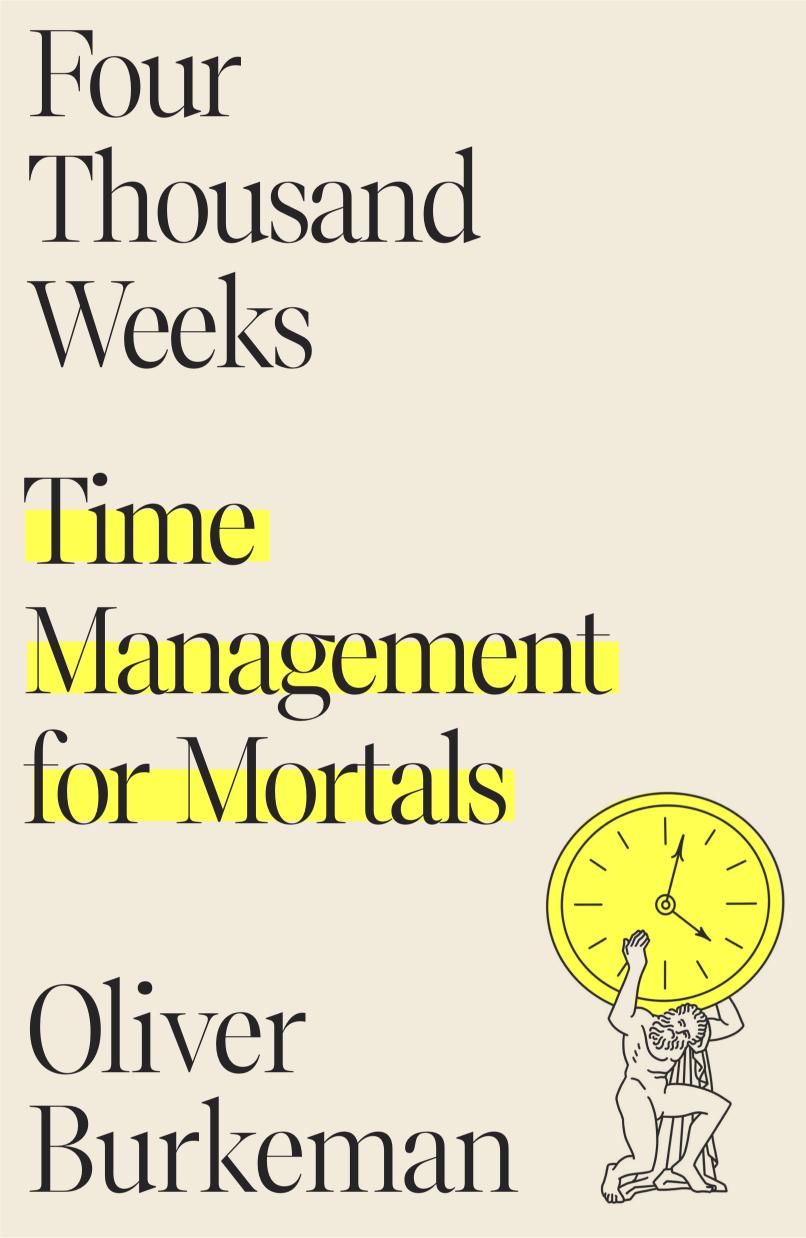
The average human lifespan is absurdly, insultingly brief. Assuming you live to be eighty, you have just over four thousand weeks. Nobody needs to be told there isn’t enough time. We’re obsessed with our lengthening to-do lists, overfilled inboxes, work-life balance, and ceaseless battle against distraction; we’re deluged with advice on becoming more productive
and efficient and life hacks to optimize our days. But such techniques often end up making things worse. The sense of anxious hurry grows more intense, and still the most meaningful parts of life seem to lie just beyond the horizon. Still, we rarely make the connection between our daily struggles with time and the ultimate time management problem: the challenge of how best to use our four thousand weeks.
Drawing on the insights of both ancient and contemporary philosophers, psychologists, and spiritual teachers, Oliver Burkeman delivers an entertaining, humorous, practical, and ultimately profound guide to time and time management. Rejecting the futile modern obsession with “getting everything done,” Four Thousand Weeks introduces readers to tools for constructing a meaningful life by embracing finitude, showing that many of the unhelpful ways we’ve come to think about time aren’t inescapable, unchanging truths, but choices we’ve made as individuals and as a society—and that we could do things differently.
“You will never finish everything, and that truth can set you free.”
“A meaningful life requires choosing what not to pursue.”
“Time feels richer when we stop racing against it.”
“The present moment is the only place life actually happens.”
Four Thousand Weeks
Nonfiction Reader
0:00
0:00
Show Podcast Text
Today we’re diving into Four Thousand Weeks by Oliver Burkeman, a thought-provoking exploration of time, productivity, and what it actually means to live a meaningful life.
The title comes from a startling calculation: if the average person lives to eighty years old, they’ll experience just over four thousand weeks. That number feels impossibly small, and Burkeman uses it to challenge our obsession with squeezing more efficiency out of every waking moment.
This isn’t a traditional productivity book filled with life hacks, color-coded calendars, or miracle morning routines. In fact, Burkeman argues that our endless pursuit of optimization often leaves us feeling more anxious, rushed, and dissatisfied. The harder we try to “get everything done,” the more overwhelmed we become.
Instead, Four Thousand Weeks asks us to confront a difficult truth: we are finite. We cannot do everything, experience everything, or become everything. And strangely, accepting that limitation can become a source of freedom.
Burkeman blends philosophy, psychology, and personal reflection to show how modern life pushes us into treating time like a resource to conquer. But meaningful living, he argues, comes from intentionally choosing what matters most and letting the rest go.
One of the book’s most powerful ideas is that fulfillment doesn’t come after completing your to-do list. It comes from being fully present in the life you already have. Whether that means deep relationships, creative work, quiet routines, or simply sitting still without distraction, the value lies in attention, not achievement.
Four Thousand Weeks feels less like a lecture and more like a conversation with someone gently reminding you that life is happening now, not someday in the future when your inbox is finally empty.
It’s reflective, surprisingly comforting, and a reminder that embracing our limits may be the key to living more fully.