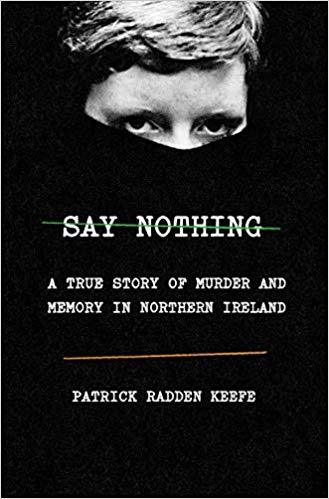
In December 1972, Jean McConville, a thirty-eight-year-old mother of ten, was dragged from her Belfast home by masked intruders, her children clinging to her legs. They never saw her again. Her abduction was one of the most notorious episodes of the vicious conflict known as The Troubles. Everyone in the neighborhood knew the I.R.A. was responsible. But in a climate
of fear and paranoia, no one would speak of it. In 2003, five years after an accord brought an uneasy peace to Northern Ireland, a set of human bones was discovered on a beach. McConville’s children knew it was their mother when they were told a blue safety pin was attached to the dress–with so many kids, she had always kept it handy for diapers or ripped clothes.
Patrick Radden Keefe’s mesmerizing book on the bitter conflict in Northern Ireland and its aftermath uses the McConville case as a starting point for the tale of a society wracked by a violent guerrilla war, a war whose consequences have never been reckoned with. The brutal violence seared not only people like the McConville children, but also I.R.A. members embittered by a peace that fell far short of the goal of a united Ireland, and left them wondering whether the killings they committed were not justified acts of war, but simple murders.
Patrick Radden Keefe writes an intricate narrative about a notorious killing in Northern Ireland and its devastating repercussions.
“Silence became survival during the darkest years of The Troubles.”
“Every act of violence left generations carrying invisible scars.”
“History and memory collide in the search for truth.”
“The cost of belief echoes long after peace agreements are signed.”
Say Nothing
Nonfiction Reader
0:00
0:00
Show Podcast Text
Today, we’re diving into Say Nothing by Patrick Radden Keefe, a gripping work of narrative nonfiction that examines murder, memory, and political violence during The Troubles in Northern Ireland. At the center of the story is Jean McConville, a widowed mother of ten who was abducted from her Belfast home in 1972 by masked intruders. Her children never saw her again. Decades later, the discovery of her remains reopened painful questions about justice, loyalty, and silence.
Keefe uses McConville’s disappearance as the doorway into a much larger story about the violent conflict between Irish republicans, loyalists, the British Army, and the people trapped between them. The book carefully reconstructs the atmosphere of fear that consumed Belfast, where neighbors distrusted one another and speaking openly could carry deadly consequences. Silence became survival during the darkest years of The Troubles.
One of the most compelling aspects of Say Nothing is its focus on individuals shaped by the conflict. Figures like Dolours Price, Brendan Hughes, Bobby Sands, and Gerry Adams emerge not as simple heroes or villains, but as deeply complicated people wrestling with ideology, trauma, and regret. Every act of violence left generations carrying invisible scars.
Readers praised the book for combining investigative journalism with the pacing of a thriller. Keefe spent years researching interviews, secret recordings, and historical archives, creating a narrative that feels both intimate and expansive. History and memory collide in the search for truth.
What makes Say Nothing unforgettable is its refusal to offer easy answers. The book challenges listeners to consider whether political causes can ever justify brutality, and whether peace truly heals old wounds. The cost of belief echoes long after peace agreements are signed.