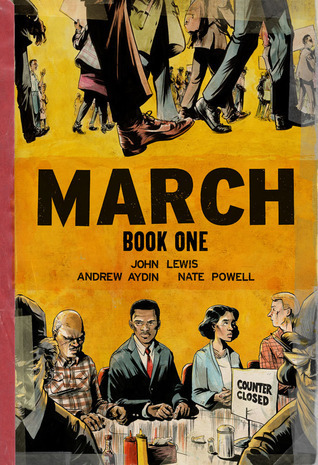
March is a vivid first-hand account of John Lewis’ lifelong struggle for civil and human rights, meditating in the modern age on the distance traveled since the days of Jim Crow and segregation. Rooted in Lewis’ personal story, it also reflects on the highs and lows of the broader civil rights movement. Book One spans John Lewis’ youth in rural Alabama, his
life-changing meeting with Martin Luther King, Jr., the birth of the Nashville Student Movement, and their battle to tear down segregation through nonviolent lunch counter sit-ins, building to a stunning climax on the steps of City Hall.
Many years ago, John Lewis and other student activists drew inspiration from the 1950s comic book Martin Luther King and the Montgomery Story. Now, his own comics bring those days to life for a new audience, testifying to a movement whose echoes will be heard for generations.
“History lives through ordinary people refusing to stay silent.”
“Nonviolence became both shield and strategy in the fight for equality.”
“March transforms history lessons into deeply human experiences.”
“John Lewis reminds readers that courage often begins with small, quiet acts.”
March
Nonfiction Reader
0:00
0:00
Show Podcast Text
Today, we’re exploring March, the groundbreaking graphic memoir by civil rights icon John Lewis, written with Andrew Aydin and illustrated by Nate Powell. More than a history lesson, this powerful first volume invites readers directly into the struggle for equality during the American Civil Rights Movement.
March begins in rural Alabama, where a young John Lewis grows up on a farm, preaching sermons to chickens while dreaming of becoming a minister. Those surprisingly tender childhood stories give the memoir warmth and humanity before the narrative shifts into the harsh realities of segregation and Jim Crow America. Lewis’s life changes forever after hearing Martin Luther King Jr. speak about nonviolent resistance, inspiring him to dedicate himself to justice and social change.
The memoir follows Lewis as he joins the Nashville Student Movement and participates in courageous lunch counter sit-ins designed to challenge segregation peacefully. What makes March unforgettable is how personal it feels. Readers experience fear, determination, hope, and sacrifice through Lewis’s own memories. Nate Powell’s black-and-white illustrations add emotional intensity, capturing crowded protests, tense confrontations, and quiet moments of reflection with cinematic energy.
Reviewers often praise March for making history feel immediate and deeply human. Many describe the trilogy as educational, emotional, and shockingly relevant today. The themes of racial injustice, peaceful resistance, and collective action still resonate strongly in modern conversations about equality and social change.
At its heart, March is about courage. It reminds readers that movements are built by ordinary people willing to stand together, speak out, and persist despite fear. John Lewis’s story is not only inspiring; it’s essential reading for anyone seeking to understand the continuing fight for civil and human rights.