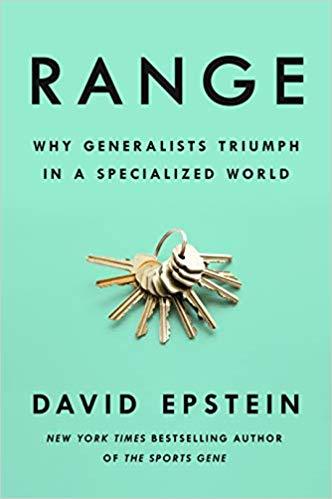
Plenty of experts argue that anyone who wants to develop a skill, play an instrument, or lead their field should start early, focus intensely, and rack up as many hours of deliberate practice as possible. If you dabble or delay, you’ll never catch up to the people who got a head start. But a closer look at research on the world’s top performers, from professional
athletes to Nobel laureates, shows that early specialization is the exception, not the rule.
David Epstein examined the world’s most successful athletes, artists, musicians, inventors, forecasters and scientists. He discovered that in most fields—especially those that are complex and unpredictable—generalists, not specialists, are primed to excel. Generalists often find their path late, and they juggle many interests rather than focusing on one. They’re also more creative, more agile, and able to make connections their more specialized peers can’t see.
Provocative, rigorous, and engrossing, Range makes a compelling case for actively cultivating inefficiency. Failing a test is the best way to learn. Frequent quitters end up with the most fulfilling careers. The most impactful inventors cross domains rather than deepening their knowledge in a single area. As experts silo themselves further while AI threatens the jobs once reserved for highly focused humans, people who think broadly and embrace diverse experiences and perspectives will increasingly thrive.
“Generalists connect ideas specialists never notice.”
“Exploration often creates stronger long-term success than early specialization.”
“Failure can become the fastest route to growth.”
“Range matters most in unpredictable and complex environments.”
Range
Nonfiction Reader
0:00
0:00
Show Podcast Text
Today we’re diving into Range by David Epstein, a fascinating challenge to one of modern culture’s biggest assumptions: that success only comes through early specialization and relentless focus.
For years, we’ve been told the same story. Start young, practice constantly, and dedicate yourself to one craft if you want to become exceptional. Epstein argues the opposite. Through stories of athletes, scientists, musicians, inventors, and entrepreneurs, he shows that many top performers actually begin by exploring widely before eventually finding their direction.
One of the book’s most memorable comparisons is between Tiger Woods and Roger Federer. Woods specialized in golf almost from birth, while Federer sampled many sports before committing to tennis. Epstein uses these examples to show that although specialists thrive in predictable environments, generalists often excel in complex and rapidly changing worlds.
The central argument is that breadth creates adaptability. Generalists are more likely to connect ideas across disciplines, solve unfamiliar problems, and think creatively under pressure. The book also pushes back against the fear of quitting. Epstein argues that changing direction is not weakness; sometimes it’s the smartest decision a person can make.
Reviewers praised the book’s engaging stories and surprising research. Readers especially enjoyed the examples involving science, medicine, sports, and innovation. Some critics, however, felt the book repeated its core message too often or relied heavily on anecdotes instead of stronger scientific conclusions.
Still, the message resonates deeply in a world obsessed with hyper-specialization. As technology automates narrow expertise, the ability to think broadly becomes increasingly valuable.
Range ultimately reminds us that wandering is not wasted time. Trying different paths, failing occasionally, and developing multiple interests may actually prepare people for more meaningful and creative success than a perfectly straight career path ever could.