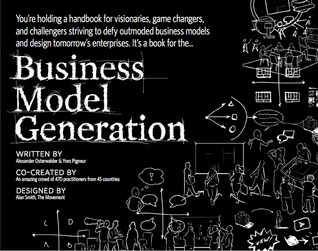
Business Model Generation is a practical, inspiring handbook for anyone striving to improve a business model or craft a new one. 1) Change the way you think about business models Business Model Generation will teach you powerful and practical innovation techniques used today by leading companies worldwide. You will learn how to systematically understand, design,
and implement a new business model or analyze and renovate an old one.
2) Co-created by 470 strategy practitioners
Business Model Generation practices what it preaches. Co-authored by 470 Business Model Canvas practitioners from 45 countries, the book was financed and produced independently of the traditional publishing industry. It features a tightly-integrated, visual, lie-flat design that enables immediate hands-on use.
3) Designed for doers
Business Model Generation is for those ready to abandon outmoded thinking and embrace new, innovative models of value creation: executives, consultants, entrepreneurs and leaders of all organizations.
“A business model is the story of how value reaches customers.”
“The Business Model Canvas turns ideas into visible, testable strategies.”
“Innovation begins when companies stop thinking only about products.”
“Great businesses evolve because their models evolve with them.”
Business Model Generation
Nonfiction Reader
0:00
0:00
Show Podcast Text
Today we’re exploring Business Model Generation, the influential guide by Alexander Osterwalder and Yves Pigneur that transformed how entrepreneurs, startups, and global companies think about building successful businesses.
This isn’t a traditional business book packed with dense theory and corporate jargon. Instead, it’s a visual, practical handbook centered around one powerful concept: the Business Model Canvas. The canvas breaks every business into nine essential building blocks, including customer segments, value propositions, revenue streams, key partnerships, and cost structures. Together, they create a complete picture of how a company creates, delivers, and captures value.
What makes this book stand out is its accessibility. Readers repeatedly praise the clean design, illustrations, and hands-on approach. Many describe it as a book that makes strategy feel creative rather than intimidating. Instead of writing endless business plans, the authors encourage experimentation, prototyping, and customer-focused thinking.
The reviews also highlight how widely applicable the ideas are. Entrepreneurs use the framework to launch startups, consultants apply it to clients, and established companies redesign outdated systems around innovation. Readers especially appreciate the emphasis on understanding customers first, rather than becoming trapped in organization-centered thinking.
At the same time, some reviewers argue the book occasionally favors style over depth. Certain sections can feel repetitive, and experienced professionals may find parts too introductory. Yet even critics admit the framework itself is remarkably useful.
Ultimately, Business Model Generation succeeds because it changes the way people visualize business. It teaches that innovation isn’t only about inventing products. Sometimes the real breakthrough comes from redesigning the model behind the business itself.