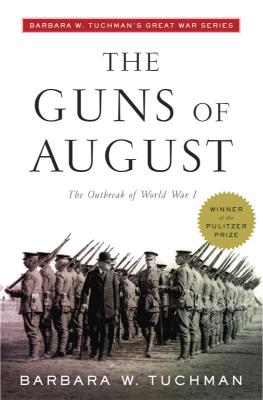
In this landmark, Pulitzer Prize–winning account, renowned historian Barbara W. Tuchman re-creates the first month of World War I: thirty days in the summer of 1914 that determined the course of the conflict, the century, and ultimately our present world. Beginning with the funeral of Edward VII, Tuchman traces each step that led to the inevitable clash. And inevitable
it was, with all sides plotting their war for a generation. Dizzyingly comprehensive and spectacularly portrayed with her famous talent for evoking the characters of the war’s key players, Tuchman’s magnum opus is a classic for the ages.
Praise for The Guns of August
“A brilliant piece of military history which proves up to the hilt the force of Winston Churchill’s statement that the first month of World War I was ‘a drama never surpassed.’”—Newsweek
“More dramatic than fiction . . . a magnificent narrative—beautifully organized, elegantly phrased, skillfully paced and sustained.”—Chicago Tribune
“A fine demonstration that with sufficient art rather specialized history can be raised to the level of literature.”—The New York Times
“[The Guns of August] has a vitality that transcends its narrative virtues, which are considerable, and its feel for characterizations, which is excellent.” —The Wall Street Journal
“The first month of war reshaped the entire twentieth century.”
“Pride and rigid plans pushed Europe toward catastrophe.”
“Victory seemed glorious until reality arrived in the trenches.”
“History changes when leaders refuse to question their assumptions.”
The Guns of August
Nonfiction Reader
0:00
0:00
Show Podcast Text
Today we’re exploring Barbara W. Tuchman’s masterpiece, The Guns of August, a gripping account of the opening month of World War I. Winner of the Pulitzer Prize, this landmark history transforms diplomacy, military strategy, and political arrogance into a dramatic narrative that feels more like a suspense novel than a history book.
Tuchman begins with the funeral of King Edward VII in 1910, where Europe’s monarchs gathered in dazzling ceremony, unaware they stood at the edge of catastrophe. From there, she traces the alliances, ambitions, and rigid military plans that pulled nations into war after the assassination of Archduke Franz Ferdinand.
What makes this book unforgettable is its focus on human error. Generals and politicians believed war would be swift, glorious, and controlled. Instead, pride and inflexible strategies created chaos almost immediately. Germany pushed through Belgium under the Schlieffen Plan, France launched reckless offensives driven by patriotic confidence, and Britain entered the conflict to defend Belgian neutrality. Every decision accelerated disaster.
Reviewers praise Tuchman’s vivid storytelling and sharp character portraits. Leaders appear brilliant one moment and painfully shortsighted the next. The book captures both the enormous scale of the conflict and the deeply personal flaws that shaped history. Readers often describe the narrative as intense, elegant, and surprisingly accessible despite the complexity of the events.
At the same time, some critics note that Tuchman occasionally leans heavily on national stereotypes and spends less time on certain fronts of the war. Yet even those readers acknowledge the extraordinary power of her writing and research.
The Guns of August remains essential because it reminds us how quickly confidence, miscalculation, and nationalism can spiral into tragedy. More than sixty years after publication, its lessons still feel urgent today.