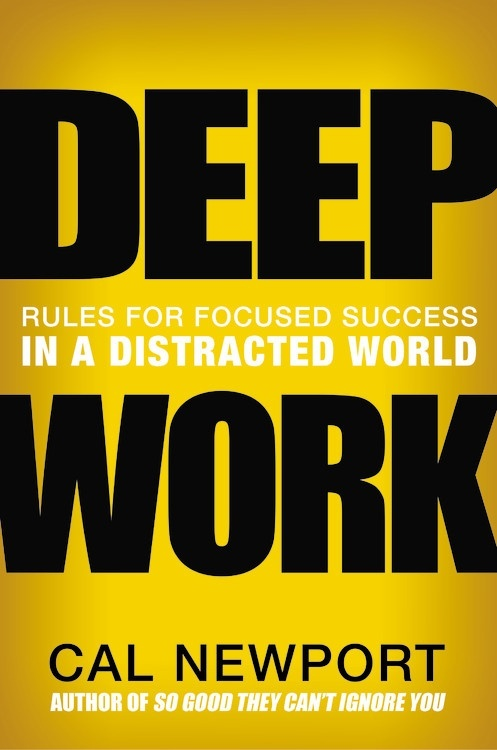
One of the most valuable skills in our economy is becoming increasingly rare. If you master this skill, you’ll achieve extraordinary results. Deep work is the ability to focus without distraction on a cognitively demanding task. It’s a skill that allows you to quickly master complicated information and produce better results in less time. Deep work will make you
better at what you do and provide the sense of true fulfillment that comes from craftsmanship. In short, deep work is like a super power in our increasingly competitive twenty-first century economy. And yet, most people have lost the ability to go deep-spending their days instead in a frantic blur of e-mail and social media, not even realizing there’s a better way.
In Deep Work, author and professor Cal Newport flips the narrative on impact in a connected age. Instead of arguing distraction is bad, he instead celebrates the power of its opposite. Dividing this book into two parts, he first makes the case that in almost any profession, cultivating a deep work ethic will produce massive benefits. He then presents a rigorous training regimen, presented as a series of four “rules,” for transforming your mind and habits to support this skill.
A mix of cultural criticism and actionable advice, Deep Work takes the reader on a journey through memorable stories-from Carl Jung building a stone tower in the woods to focus his mind, to a social media pioneer buying a round-trip business class ticket to Tokyo to write a book free from distraction in the air-and no-nonsense advice, such as the claim that most serious professionals should quit social media and that you should practice being bored. Deep Work is an indispensable guide to anyone seeking focused success in a distracted world.
“Deep work is a superpower in a distracted world.”
“Attention is now one of the rarest professional skills.”
“Shallow habits quietly steal our best ideas.”
“Focus creates craftsmanship, meaning, and lasting results.”
Deep Work
Nonfiction Reader
0:00
0:00
Show Podcast Text
Today we’re diving into Deep Work by Cal Newport, a book that challenges the way we think about productivity, attention, and success in the modern world. Newport argues that the ability to focus deeply, without distraction, has become both incredibly valuable and increasingly rare. In an age of nonstop notifications, endless emails, and addictive social media feeds, most people spend their days trapped in what he calls “shallow work” — tasks that feel busy but create little lasting value.
The book combines cultural criticism with practical advice. Newport shares stories of high performers who deliberately isolate themselves from distractions to produce meaningful work. From academics to entrepreneurs, the pattern is consistent: concentrated focus leads to exceptional results. Deep work is not just about working harder; it’s about working with intensity and purpose.
One of the most powerful ideas in the book is that attention is trainable. Newport explains that every time we give in to distraction, we weaken our ability to concentrate. On the other hand, practicing sustained focus strengthens the mind like a muscle. He encourages readers to schedule uninterrupted work sessions, reduce unnecessary social media use, embrace boredom instead of constant stimulation, and create rituals that support concentration.
What makes this book resonate is its practicality. Even critics who found the message repetitive admitted the core idea was valuable. Deep work reminds us that meaningful achievement rarely comes from multitasking. It comes from protecting time, directing energy intentionally, and creating space for real thinking.